
ISSUE #3 June-July 2026
Welcome to The Great Deep newsletter!
Our goal is to have items of interest both to newcomers and to "old hands" who have been reading about HPT for many years. We'll try to keep you up-to-date on news that is buzzing about the HPT community.
If you missed a past issue, they are posted on hydroplate.org (click on NEWSLETTER).
New to Hydroplate Theory? You can watch a very short video introduction by clicking here.
UPDATE on the 9th edition:
Copies have been sent to Amazon. This means that any day now you will be able to order your copy (or several copies to give to friends and family!) through Amazon. There have been a few hitches in getting the listing to show up, so if it isn't up already it will be up very soon.
PLEASE CONSIDER leaving a 5-star review!
AND: The ITB flip-book is already here:
You can now read the 9th edition online: creationscience.com
NOTE: New format is that you are required to enter your email address to view the online flip-book, to help keep the site secure. Thank you!

NEW! A Facebook page devoted to HPT!
Facebook.com/Hydroplate.Theory.Official
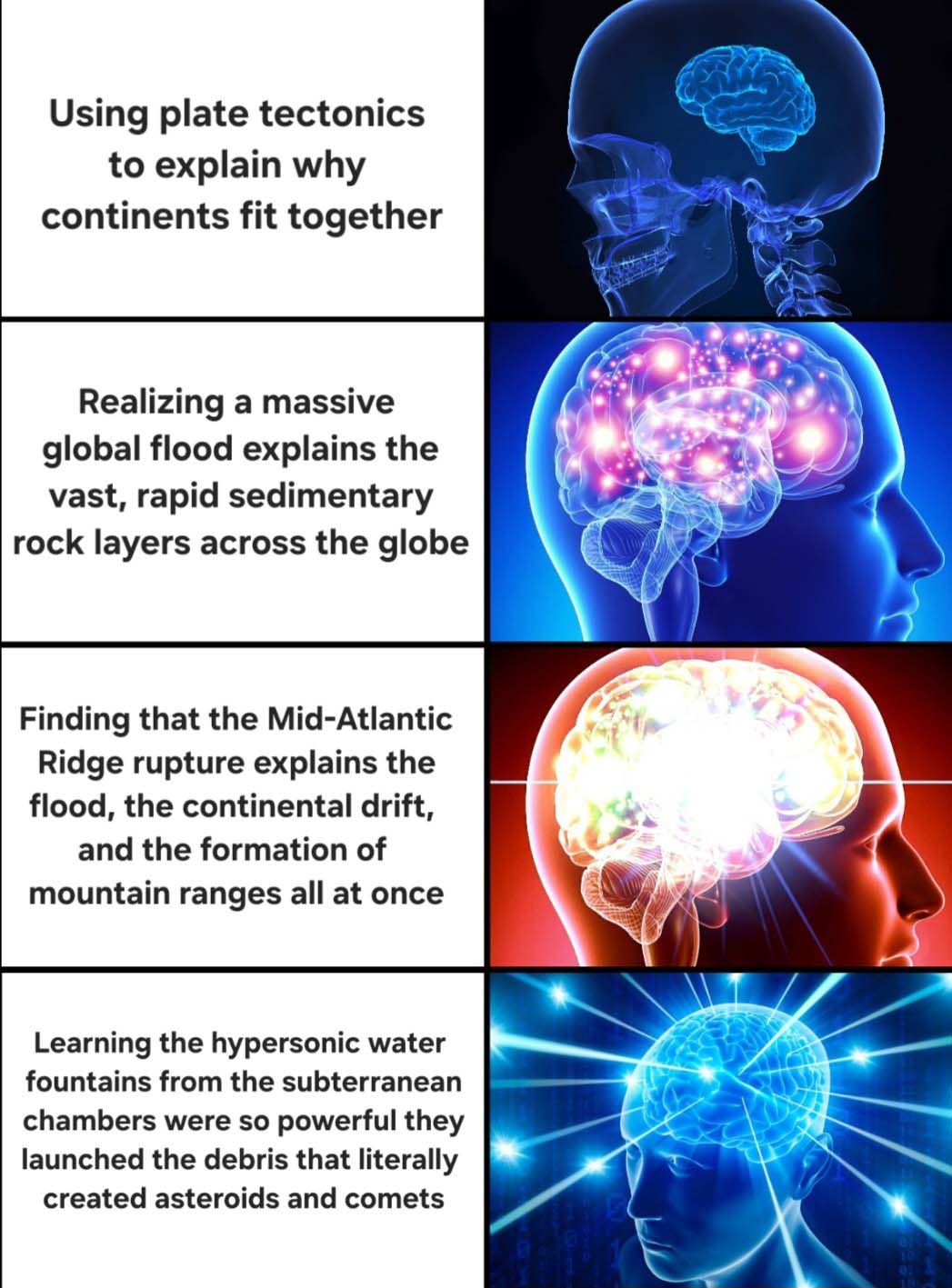
This page will be updated multiple times per week, with all kinds of posts, announcement of events, shorts from recent videos, and some entertaining memes for you enjoyment. Information and humor all in one place!

FEATURED HPT SUPPORTER: Daniel Friedman
UPCOMING EVENT: July 10 at 7:00 PM EST
HYDROPLATE THEORY vs. PLATE TECTONICS
on "Standing for Truth" Youtube channel
Brian Lauer takes on Dr. Howard Feldman
OPINION PIECE: HPT not in conflict with BEDS theory of Megasequences
Although large creation groups tend to favor non-HPT explanations for the overall mechanism of the Flood, we should not automatically dismiss all of their ideas and research. In fact, sometimes HPT can actually provide a robust explanation for some of their sub-models.
The BEDS theory (Briefly Exposed Diluvial Sediments) was initially proposed to explain fossilized footprints in areas were no bodies are found. Sometimes the footprints have strange patterns, almost as if the animal was being lifted up and down. The footprints would disappear for a stretch, then reappear. What could lift a large animal? Water. In the early days of the flood, the world was not yet covered with water. Probably all parts of the globe had been soaked pretty thoroughly and may have already been covered with some layers of wet sediments, but high elevations were not yet covered. Animals would have been seeking high ground, running as fast as they could. According to the BEDS theory, as the water levels rose, some places would have experienced intermittent surges of water. Animals running along damp sediments created footprints, then they were lifted and began to float as a swell of water passed over the land. As the swell receded, the animals were gently lowered back down onto the sediments to create more tracks. When the animal eventually drowned it was at a location distant from the tracks. In fact, rarely are footprints found near body fossils. The bodies are also found higher up in the fossil record, a mystery for anyone who doesn’t believe in the Flood.
Far from being a challenge to HPT, the BEDS theory is quite compatible with it. The CPT theory only has massive wave action to explain why certain areas of land were exposed on and off during the early flood. CPT doesn’t have any way of actually lifting the ground. HPT has “fluttering,” where the crust heaved up and down as the subterranean water surged out from underneath it. Parts of the crust were experiencing rising and falling elevation due to the fluttering. This action could be the underlying explanation for BEDS.
Geologists at ICR have been publishing articles about Megasequences for a number of years now. This idea is the result of excellent research done by Tim Clarey et al. at ICR. A megasequence is series of layers that all appear to be related, as if they were laid down together in a short amount of time. In his book, Carved in Stone, Clarey shows maps of the land covered by each megasequence and an approximate time table for when each sequence might have occurred during the flood. Some megasequences stretch across most of North America, or can even be traced onto other continents. Again, CPT advocates have only wave action as their mechanism--tsunamis that they claim occurred due to plate tectonic mechanisms initiated by miracles. HPT can help to explain megasequences by offering a mechanism that would create massive surges in sediments washing across continents. We don’t know for sure what and when everything came out from the subterranean chamber, but we do have a source of massive amounts of watery sediments pulsing over the continents. This is a space where ICR and HPT can come together and help each other solve some sedimentary mysteries.
Submitted by Ellen McHenry
A DEBATE TO CATCH UP ON IF YOU MISSED IT:
"The Formation of the Grand Canyon" on "Standing for Truth"
Technical note of the month: Basalt vs. Mantle Rock
Was the pre-Flood mantle made of basalt? No. It is likely that there wasn’t any basalt in the pre-Flood world because basalt is formed as the result of the melting of mantle minerals. HPT asserts that the pre-Flood earth had not experienced any melting previous to the shattering of the crust.
Basalt, a hard, gray/black rock, covers most of the ocean floors. (It is also found on land, including some amazing formations such as the Giant’s Causeway in Ireland, where it formed a pavement of hexagonal columns.)

When the crust opened up and allowed the mantle to rise, there was massive melting simply due to decompression. (Later, fracturing and shearing in the mantle would also produce additional magma, some of which came to the surface.) As the mantle rock was allowed to expand, energy was released and much of it was converted to heat. The minerals that comprised the mantle melted into a runny lava that covered the surface of the mantle--the future ocean floors. The lava then cooled into a thick layer of basalt. This basalt layer is so thick that oceanographers today have not been able to drill deep enough to bring up a sample of the unmelted mantle underneath it. On the continents, the mantle is buried even deeper because it is under 20-40 miles of granitic rock.
The only experimental evidence we have about deep, unmelted mantle rock comes from two sources: 1) seismic data (how fast earthquake waves travel through various type of rock, and 2) rare instances of “xenoliths.” Xenoliths are believed to be unmelted mantle minerals that got swept up along with magma that was coming to the surface. (An alternate explanation is that the xenoliths were already cooling into crystals when the magma came to the surface.) Seismic data has proven to be unreliable in notable cases, such as in places where very deep holes were drilled. The rocks brought up from the holes did not match the seismic predictions. However, seismic data should not be totally tossed out. We do know for sure that seismic waves travel faster through more dense materials, so the speed of waves might help us to narrow down the possibilities of rock types.

The picture on the left shows a bright green xenolith made of the mineral olivine that is embedded in a chunk of black basalt. Olivine is believed to be one of the primary minerals in the mantle. We don’t tend to think of the inside of the earth as being green, but why not? On the surface of the earth (on land), green is the predominant color. Why not under the earth, as well? The other common mantle mineral is thought to be pyroxene, shown in the middle image, which can also be green (or black). Together, olivine and pyroxene form peridotite (peh-RID-o-tite), shown on the right.
All this pretty green goes away when these minerals melt. And those nice little crystals? Gone. They turn into gray/black, homogenous, boring-looking basalt. This is a one-way process. You can’t transform basalt back into olivine and pyroxene. It’s like the proverbial egg that you can’t unscramble.
So... the next time you are explaining to someone HPT’s initial conditions, make sure you correctly describe the pre-Flood mantle as being made not of basalt but of peridotite, a combination of the beautiful greens and blacks of olivine and pyroxene. Although the ocean floors are now several miles deep in basalt, far under the ocean at least some of the mantle (not close to fractures) is likely still a gorgeous green.
Additional technical note: As you go deeper into the mantle, extreme pressure begins to change the crystal shapes of the minerals. Every time the crystal shape changes, even if the chemistry remains the same, the mineral gets renamed. For most of us, mineralogy has far too many names to remember. This article has tried to keep it simple.
RAQ's (Recently Asked Questions)
In this section we will answer some questions that people have asked.
Q#1: Did Dr. Brown consider Pluto to be a created planet?
A: On page 364 of the 9th edition he classifies Pluto as one of the largest TNOs. On page 36 he tells about meeting the man who discovered Pluto, Dr. Clyde Tombaugh. Check out page 36 to find out more about Walt's relationship with Dr. Tombaugh.
Would you like to submit a question for our next issue? Send an email to: info@hydroplate.org
HPT gift ideas: Mugs, T-shirts and totes: https://www.zazzle.com/s/hydroplate+theory
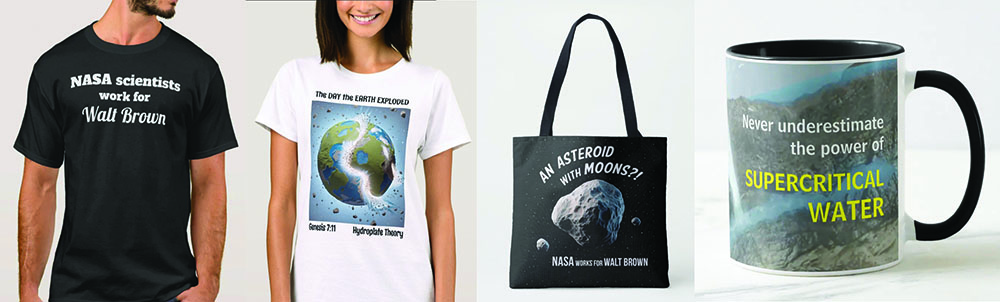
These T's, totes and mugs are perfect for home, office, work, sporting event, the gym, etc.-- anywhere that you'd like to have a conversation starter. It's a bit socially awkward to just walk up to someone and say, "Hey, would you like to hear about an amazing flood model?" It's much easier to simply answer questions like, "Why is it strange for an asteroid to have moons?" or "What is supercritical water? What does it do?" or "You're crazy to think the earth "exploded"! How could that ever happen?" or "Why do all scientists work for Walt Brown? Who is he?" These questions give you a great opportunity to introduce HPT. Tell them if they want to know more, just go to HYDROPLATE.ORG. This website name will hopefully be easy enough to remember even without writing it down (e.g. if this conversation is happening at the gym while both of you are riding stationary bikes).
(NOTE: The prices of these products are set as low as the company will allow. The point is not making money. The tiny bit of profit earned will go into funds that directly benefit HPT events, advertising, etc.)
THANKS FOR SIGNING UP FOR THE NEWSLETTER!
Please let other HPT supporters know about it.
Tell them to go to hydroplate.org and click NEWSLETTER in the menu.